About

Showing posts with label healing herbs. Show all posts

Saturday, March 2, 2013

Lavender And Its Many Health Benefits


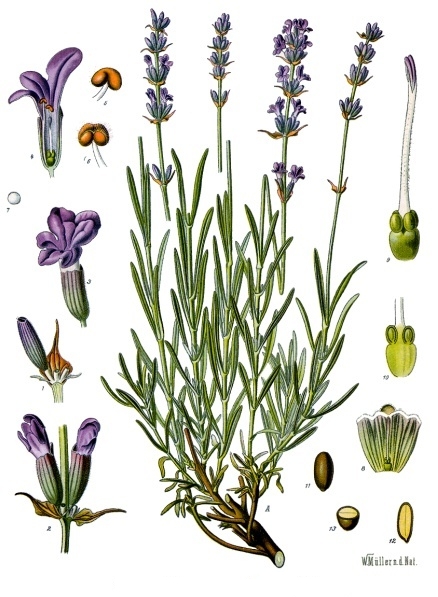
Besides smelling wonderful, Lavender (Lavandula angustifolia) actually has many healthful benefits. You'll probably be surprised by how many, I know I was. Used as aromatherapy, a tea, and with dried or fresh buds it can help with a myriad of health issues. Lavender is a calmative, and has antiseptic, anti-inflammatory, antifungal  and disinfectant properties. It contains antioxidants (polyphenols) and is chock full of phytonutrients for good health.

Lavender oil should always be diluted and used sparingly.  It is very potent.

ANXIETY, STRESS, TENSION, DEPRESSION-  Rub some essential oil into your temples and/or under your nose. Or soak in a hot bath that you've added flower buds or oil.

APPETITE LOSS- Breathing lavender aromatherapy for 15 minutes can stimulate the appetite.

DEMENTIA-  Lavender oil has been found to lower aggressiveness and 'agitated behavior' in dementia patients when used as part of massage therapy.

HAIR TROUBLES-

    a. Alopecia (hair loss): When rubbed into the scalp. Combine with oils of cedarwood, thyme, and rosemary. Could increase hair growth by 44% in 7 months. The WebMD recipe is as follows:

For bald spots (alopecia areata): one study used a combination of essential oils including 3 drops (108 mg) of lavender, 3 drops (114 mg) of rosemary, 2 drops (88 mg) of thyme, and 2 drops (94 mg) of cedarwood, all mixed with 3 mL jojoba oil and 20 mL grapeseed oil. Each night, the mixture is massaged into the scalp for 2 minutes with a warm towel placed around the head to increase absorption.


  b. Dandruff: Steep flowers in hot water, cool, and use as a rinse until the flakes disappear.  You can also add 15 drops of lavender essential oil to 2 tablespoons of almond, olive or white sesame seed oil,  microwave until warm (about 10 seconds or so), massage scalp with the concoction, put on a disposable shower cap, let sit for an hour, then shampoo out.  This also might take a few goes to notice a difference.  You could also add some essential oil to your shampoo or conditioner.

  c. Lice and Nits: Apply oil to a comb and comb through hair. It supposedly kills the nits.

INSOMNIA-  Inhale some lavender essential oil before bed time, or put some on your pillow. You can also steep some lavender flowers in hot water to help relax and promote sleep, drink before bed. Adding some chamomile to the lavender could double the effect. Turn on a diffuser with lavender oil at night. Place a vase of dried lavender next to your bed.

PAIN- When inhaled, it can also help reduce pain, probably by reducing anxiety. Massaged, it can  help with joint pain, and headaches.

SKIN TROUBLES- 

   a. Mosquito Bites: Get rid of the itch with essential oil. Dab a few drops of essential oil on the bite, wait 15 minutes.  Then reapply every 6 to 8 hours for 24 hours.  If the skin gets irritated within the first 15 minutes, stop using.

  b. Burns or Irritations: Add some oil to moisturizer or hand lotion, or to some water in a spray bottle.

TUMMY TROUBLES- Add food-grade dried lavender to some yogurt to help with bloating and poor digestion, especially from antibiotic use. The polyphenols help with the bad bacteria in the gut.


Besides the above, it has been known to help with many other ailments including acne, asthma, colic, cuts, flatulence, hay fever,  nausea, vomiting,

SIDE EFFECTS AND INTERACTIONS: Although lavender is generally safe, there are some potential issues you should consider before using.  If you are trying to lose weight, you should probably stay away from lavender since it can stimulate the appetite. It can also cause constipation, headache, and skin irritations. Stop using lavender in any form at least two weeks before a scheduled surgery since it can slow down the central nervous system too much when used in conjunction with general anesthesia.  Apparently, it's also not a good idea to use on  pre-pubescent boys because of hormonal issues: it can cause gynecomastia (abnormal breast growth). It's probably best to not use on any young children. Diabetics should also stay away from lavender use. And as always, pregnant and lactating women should stay away. And here is some important information on interactions.

Unless you know for sure the lavender is safe to ingest, do not take orally.

Please remember always check with your doctor or health practitioner before you use any herbal remedy.


Sources: HuffPo, Marks Daily Apple, Health Cave, WebMD,

Tuesday, December 11, 2012

Mistletoe Extract Potential Colon Cancer Cure

Photo: Wikipedia
When I think of mistletoe, I think of Christmas, and songs like "I Saw Mommy Kissing Santa Claus (underneath the mistletoe)", because that's all it's good for, right? Snatching a loving kiss from your sweetie underneath a hanging piece of Mistletoe. Wrong. I wasn't aware that Mistletoe actually had any medicinal properties, but it does, and it's a biggie.

Australian scientists at the University of Adelaide have been experimenting with Mistletoe extract and have found that it has huge potential for helping with colon cancer, either as a complementary holistic treatment along with chemotherapy, or even as an alternative healing modality.

What's amazing is that it was a student, Zahra Lotfollahi, who discovered the efficacy of Mistletoe extract while working on her Honours research project at the University of Adelaide. Comparing three different extracts in conjunction with chemotherapy on both colon cancer cells and healthy cells, she discovered that one in particular from the Fraxini species- grown on ash trees- was able to kill cancer cells better than chemo, and without the harsh side effects.  Lotfollahi said:

"This is an important result because we know that chemotherapy is effective at killing healthy cells as well as cancer cells. This can result in severe side effects for the patient, such as oral mucositis (ulcers in the mouth) and hair loss."

"Our laboratory studies have shown Fraxini mistletoe extract by itself to be highly effective at reducing the viability of colon cancer cells. At certain concentrations, Fraxini also increased the potency of chemotherapy against the cancer cells.

"Of the three extracts tested, and compared with chemotherapy, Fraxini was the only one that showed a reduced impact on healthy intestinal cells. This might mean that Fraxini is a potential candidate for increased toxicity against cancer, while also reducing potential side effects. However, more laboratory testing is needed to further validate this work."


According to her supervisor, Professor Gordon Howarth:

"Although mistletoe grown on the ash tree was the most effective of the three extracts tested, there is a possibility that mistletoe grown on other, as yet untested, trees or plants could be even more effective.

"This is just the first important step in what we hope will lead to further research, and eventually clinical trials, of mistletoe extract in Australia,"

Howarth claims the extract has been available in Europe and other countries overseas, but not in the the United States or Australia, hence the need for research. I'm sure much has to do with big pharma, since there's not any money to be made with natural alternatives, but hopefully something will come of this.

Although lung and bronchial cancer is the number one cancer killer in the West, colon cancer comes in second.

Some fun facts on Mistletoe that I had no clue about:

1. It's parasitic. Like a fungus, it grows on trees and shrubs. "As it grows, it burrows into its host, and draws nutrients from the tree", a little like a vampire.

2.  It can be slightly toxic to humans, so not something you'd want to munch on.

3.  Using Mistletoe as a holiday decoration pre-dates Christianity, and was considered  a fertility symbol.
According to legend, Baldur, the god of light, began to have terrible nightmares that he would soon be killed. To ease his mind, Baldur’s mother, Frigga, undertook a journey to make everything in heaven or Earth – plants, animals, weapons, and so on – swear an oath not to harm Baldur. Because her son was so universally loved, everything she asked gladly made this promise. Unfortunately, the goddess overlooked the humble mistletoe. Realizing Frigga’s mistake, Loki, the god of mischief and fire, fashioned a spear of mistletoe and tricked Baldur’s blind twin brother, Hodur, into throwing it at the light god. The mistletoe pierced Baldur’s heart, killing him and bringing darkness to the world. Being magical, the gods were eventually able to resurrect Baldur. To celebrate his return, Frigga declared that mistletoe would be a symbol of love, and commanded gods and humans to kiss beneath its leaves in memory of her son. Some versions of the myth, though, say Loki foiled the gods’ attempt to restore Baldur to life. In this case, it is prophesied that the light god will return at Ragnarok, the destruction and rebirth of the world, and the mistletoe kiss is a foretaste of the joy that is yet to come.

And more fun facts.

This is good news, now we just need the FDA to approve it. Of course that means it will be available, if at all, when I'm dead and gone.

Sources: Newswise

Saturday, May 19, 2012

Herbs For Sunburn Relief

Summer is almost upon us, at least for those in the Northern Hemisphere; although this year- for some- it already feels like summer. With the hot summer months come vacations and those lazy days hanging out in the sun in your backyard, or at a park or pool, or on a towel on a sandy beach. Some sun is good, we need daily doses to stock up on our Vitamin D which is a very necessary preventative for many diseases, but too much can create all sorts of health issues from sunburn to skin cancer to premature aging.

The average person only needs about 10 to 20 minutes a day of sun between the hours of 10 a.m. and 2 p.m. However, the actual amount needed depends on where you live, and your skin type.  Fair skinned people need far less, maybe a few minutes of midday sun, whereas very dark-skinned people need up to 4 times that amount of sun exposure a day.
So how do we get enough Vitamin D without getting a sunburn?  Using sunscreen actually prevents your body from absorbing Vitamin D, so your best bet is to sit in the sun for however many minutes your body needs to soak up the D and then slather on the UV protection for the rest of your sunbathing day. 
But if you do happen to turn lobster red, like the little girl in the Coppertone ad, there are some natural ways to help relieve pain of sunburn:
Take a cool shower or bath to stop the heating process, then gently rub one of the following into your skin:

ALOE VERA GEL-  soothes and heals the inflammation- cut open a leaf if you have a plant, or apply a store bought gel for relief,

CHAMOMILE TEA-  is great for skin irritations, so boil some tea, cool off and then apply.

GREEN TEA- the quercetin, Vitamin C and antioxidants in green tea help heal the skin. Again, apply cooled off tea to your skin.

WITCH HAZEL- also helps relieve sunburn. Apply with some cotton onto the burned area.

Here are some other home remedies for sunburn.

I have never had the patience to sit in the sun, so have never had to deal with a sunburn, but the above remedies seem relatively harmless.

Remember, if you have a severe sunburn, go see your health practitioner.

Monday, December 19, 2011

Clearing A Stuffy Nose The Natural Way

Not being able to breathe through a stuffed-up nose because of a cold, allergies or sinus problems is no fun. At least with a cold the stuffiness eventually goes away, but for those of us who deal with clogged noses on a daily basis it's terribly frustrating.   Of course, there are OTC drugs that many people use, depending on the cause of the nasal congestion, but if you're like me, I'd rather go the natural route to clear up my sinus passages.

Many people swear by Neti Pots, but with the latest news regarding two deaths potentially linked to Neti Pot usage in Louisiana, some people might be a little hesitant to use them, although they should be safe if used correctly.  So what other choices do we have?

ALTERNATIVES TO NETI POTS:

1. Simply Saline Solution: A purified saline solution that you inhale into each nostril. You can purchase this anywhere. I tried it several times, but I have very sensitive nasal passages and the solution caused some bleeding. If you are one of the rare people that can not tolerate the salt, there is another natural option.

2. White Sesame Seed Oil:  Sesame seed oil has antifungal, antibacterial, antioxidant, antiviral and anti-inflammatory properties so it's good for many uses, including clearing up that stuffy nose. This was recommended to me by my acupuncturist, who suggested  dipping a clean tissue in the sesame oil (the white not the dark), close off one nostril with your fingers and inhale deeply the oil into the other nostril. The white sesame oil is tasteless and odor free, and can be purchased at Asian markets or in most health food stores.  The only problem with the oil, is that it's a tad messy.

3. Hot Steam: Drop some eucalyptus, camphor or menthol oil into a bowl or pan of steaming hot water, drape a large towel over your head and breathe through your nose until there is no longer any steam.

4. Spicy Foods: Eating spicy hot foods will clear up nasal congestion, at least temporarily. Horseradish, Japanese wasabi mustard, Chinese hot mustard, anything with hot peppers.

5. Peppermint Candies: Chew or suck on some Altoids, or other peppermint or mint candy.

6. Acupressure Massage:  Here's a short video that demonstrates how to apply pressure to relieve sinus congestion.

This Chinese Medicine website has some additional recommendations, including the use of an eye dropper for the Sesame oil, which seems like a better choice than a tissue.

REMINDER: While these are natural remedies, there are some people who might be allergic to some of the herbs, sesame oil etc. Women who are pregnant should be particularly careful. And it is best to ask your physician or holistic health practitioner before use.

Thursday, December 15, 2011

Natural Prevention and Treatment of The Common Cold and Flu

Although it's possible to catch a cold or the flu during other seasons of the year, it's during the winter time that our chances increase tenfold.  Though many people get their recommended annual flu shot as the cold season approaches, many of us are unable to or choose not to go that route and prefer a natural method of prevention and remedy. For most people, colds and flu are a minor nuisance, but for others, especially those with certain health conditions the flu can be dangerous, even deadly.  According to the Centers for Disease Control (CDC), typically, 5 to 20 percent of the U.S. population get the flu every year, with an average of 23,600 flu-related deaths. That's a lot for an illness that usually can be prevented. As they say- an ounce of prevention.

PREVENTION:   So how does one prevent getting that nasty headache, runny or stuffy nose, sore throat, cough, fever or achy body symptoms the natural way?  It's all about keeping your immune system boosted or at least balanced, since the best way to get sick is when you happen to be run down.

So,

1.   Make sure you eat a healthy diet full of whole grains, fruits and veggies.
2.   Get some exercise and plenty of rest.
3.   Take your Vitamin D3, year round. 1,000 to 2,000 IU per day is what is now recommended for adults, and some suggest doubling that amount during peak flu season (December through March). Research shows people with Vitamin D deficiency are more prone to colds and flu.
4.   Take your Omega3s, year round.  They are great anti-inflammatories, and antibacterials.
5.   Wash your hands constantly.  Especially if you are out in public.  Carry around those handy alcohol infused hand sanitizers, like Purell, and use them.
6.   Take Astragalus root, 6 to 8 weeks before the flu season starts. This Chinese herb boosts the immune system. I have taken it in the past and it was very helpful.
7.   Yu Ping Feng Wan, is another Chinese herbal formula that can prevent the onset of the common cold when rundown.  On several occasions my Acupuncturist has given me these little round black pills, and I managed to stay cold-free.
8.   Increase your Vitamin C intake, although there are some who think this is merely hype, and that it doesn't really help.
9. Don't touch your nose, eyes or mouth.

Now one can't always prevent the flu or a cold, and some people are just more prone to them than others.  But if you do start to feel like you might be catching one, the best time to attack it is right at the onset. Some of the herbal remedies I will recommend can help either stop it in its track, or at least lessen the duration and symptoms.

AT THE ONSET:  So you feel that scratchy throat, or that tickling sensation in your nose, what do you do? You can try any of the following.

1.   Take some Echinacea/Goldenseal.  Antibacterial, antiseptic, and immune boosting, the combination of these herbs can prevent the cold from developing into its full blown nastiness.  This used to work very well for me, but the immune boosting elements of the formula is not good for my Arthritis, so I am now unable to take it. And it's not something one should take for a prolonged periods of time.
2.   Start sucking on Zinc tablets. I use Cold-Eeze. I follow the directions, but Prevention Magazine claims more than 50 mg per day, is not good. Just make sure you don't take the Zinc with any citrus fruits or liquids.
3.   Southern Ban Lan Gen Chong Ji, is a hot Chinese herbal drink that you mix with hot water and is very useful to shorten the length of a cold or flu.  This is another product that I have used and found very helpful.  It is not recommended for pregnant women or diabetics, since it has cane sugar.
4.  Eat some garlic.  People always talk about giving people with colds chicken soup, but it's not the chicken that has healing properties, it's the garlic.  Garlic is antibacterial, antifungal and antiviral.  People can be allergic to too much, so be careful.
5.  Pump yourself with Emergen-C.

WHEN SICK:  So you are now suffering with the various symptoms of cold and flu, but there are still some natural remedies that can help you get through the worst of it. First of all drink plenty of fluids, rest and stay home until at least 24 hours after your fever is gone.  Use Kleenex when you cough or sneeze, so  you don't spread the germs around. Those germs can last up to 48 hours (some claim longer) outside of the body. 

1.  Sore Throats: Gargle with warm salty water. Chew on several pepper corns- the juice will soothe the throat. It will make your eyes tear, but it helps. Take a teaspoonful of honey and swallow, honey has antibacterial properties and can soothe the throat.  Drink some hot lemon water with honey, the lemon is chock full of Vitamin C and also boosts the immune system. Remember, though, young children should not be given honey. Drink some slippery-elm tea, which also coats and soothes the throat. Ricola throat drops.  For more remedies check here.

2.   Coughs:  Fritillary and Loquat Extract, from my Acupuncturist, works wonders.  Honey is also good for coughs.  You can also try Ricola cough drops.

3.   Fever:  I have never tried it, but some people swear by egg whites to lower fever. Here are some interesting remedies for children that I'm sure would be helpful for adults.

REMEMBER if the symptoms become severe or last for a prolonged period of time, get ye to a doctor, ASAP.

PLEASE NOTE: Most of these things listed here I have used to great effect. The Chinese herbals were given to me by my Acupuncturist. Please check with your doctor or health practitioner before you embark on any herbal treatment for any condition. And please do your own research if you find something you might want to try.

Photo source.

Thursday, December 6, 2007

Feverfew For Fewer Migraines

I've never had migraines, although I used to suffer terribly from frequent headaches. I still get a whopper of a headache, once in a while, but certainly not as often as in the past. It's usually stress or pillow-related, and sometimes lasts throughout the day, finally dissipating the following morning. They're never fun, and I can empathize with migraine-sufferers who have to deal with much more than just a pounding head that they'd give anything to chop off their willing shoulders. I've had many a headache where I've felt very much like doing that, or at least paying someone to do it for me.

So, add to an agonizingly painful head: extreme sensitivity to light, nausea, and some vomiting for good measure, and you have the symptoms of a full blown migraine. I've had friends who get them, so I've seen how debilitating they can be.

If you get migraines you might want to consider:

Feverfew (Tanacetum parthenium):

It's a member of the sunflower family, and the dried leaves (along with the flowers and stems, sometimes) are used to combat not only migraines, but fevers, stomachaches, insect bites, toothaches and several other things.

A clinical study of patients taking a combination of Feverfew and White Willow (aspirin-like herb) taken twice daily for 12 weeks, reduced the frequency, intensity and duration of migraine attacks.

The Rodale Book "The Herbal Drugstore" recommends using a feverfew tincture or capsules that contain freeze-dried feverfew leaves, and NOT supplements made with dried leaves. Apparently, it won't work and could possibly worsen the migraines. They recommend taking the following daily:

15 drops of the tincture daily or
300-mg capsules per day

Though it might not work for everyone, I'd think it would be worth a try. However, as with all herbs, make sure you thoroughly research the potential side-effects etc. Further information and details of side effects etc. can be found on the above links. The following is taken from one of those websites, UMM.edu:

Precautions

The use of herbs is a time-honored approach to strengthening the body and treating disease. Herbs, however, contain components that can trigger side effects and that can interact with other herbs, supplements, or medications. For these reasons, herbs should be taken with care, under the supervision of a health care provider qualified in the field of botanical medicine.
Side effects from feverfew can include abdominal pain, indigestion, flatulence, diarrhea, nausea, vomiting, and nervousness. Mouth ulcers, loss of taste, and swelling of the lips, tongue, and mouth may occur in some individuals who chew raw feverfew leaves. Allergic reactions to feverfew, although rare, have also been reported. In fact, people with allergies to chamomile, ragweed, or yarrow will likely be allergic to feverfew and, therefore, should not take it.

Feverfew may increase the tendency to bleed, especially in individuals with bleeding disorders or taking blood-thinning medications, such as aspirin or warfarin. Do not use feverfew if you have bleeding disorders or are taking blood-thinning medications unless you are under the supervision of a doctor.
Pregnant and nursing women as well as children under 2 years of age should not take feverfew.

Do not abruptly stop taking feverfew if you have used it for more than 1 week. A withdrawal syndrome characterized by rebound headache, anxiety, fatigue, muscle stiffness, and joint pain may occur.